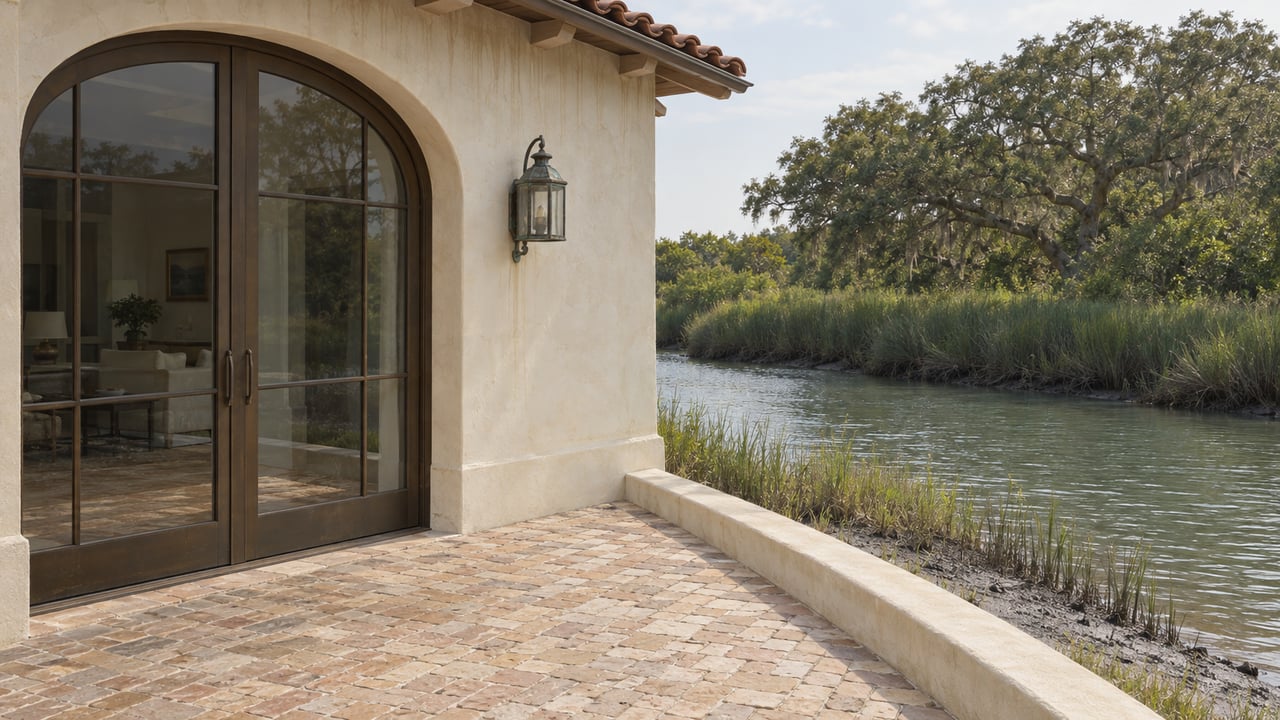
Drive down N. Hampton Club Way and the golf clubhouse announces itself first. It sits close to the road, parking lot visible, restaurant sign lit before you even reach the pro shop. A quarter mile past it and down toward the water, the neighborhood's other clubhouse gives you nothing. No sign. No lit windows. Just a fire pit, a dock, and a kayak launch tucked into the bend where the community meets Lofton Creek.
That second building is The Outpost, and for most of the year it earns its obscurity honestly. There isn't much reason to walk down there in July. But late September through the next few months is when the gap between these two spaces stops being about visibility and starts being about timing, because one of them runs on a weekly schedule and the other runs on water temperature.
A Clubhouse That Keeps a Calendar
The Golf Club at North Hampton, an Arnold Palmer design that winds through more than 40 feet of elevation change and ten spring-fed lakes, posts a routine you can set your week by: Pub Nights on a weekly rotation, wine tastings mixed in, something on the books most weeks of the year. It's the version of community life that works because it doesn't ask anything of the calendar outside. Rain or shine, warm or cool, there's a bar open and a reason to show up.
That predictability is the point, and it's also the contrast. A clubhouse that runs on a fixed schedule is built for consistency. It's not built to respond to a tide chart or a water temperature drop. That's a different kind of amenity, and North Hampton has one of those too.
A Clubhouse That Keeps a Season
The Outpost doesn't post hours because its usefulness isn't a function of the day of the week. According to the community's own description, residents have access to a private retreat on the edge of Lofton Creek with docks for fishing and kayaking, picnic pavilions, and a fire pit. Property listings in the neighborhood fill in the rest: a screened enjoyment area, a kayak launch, a fishing dock, and a fish-cleaning station, all built around the creek access point. Add the separate boat and RV storage the HOA maintains elsewhere in the community, and the pattern is clear. This isn't a decorative amenity someone added to a brochure. It's built for people who actually intend to put a line in the water or a paddle in a creek, and then clean what they catch before they walk back up the yard.
For most of the year, that infrastructure sits underused, not because it doesn't work but because the creek itself isn't offering much of a reason to visit. Late September changes that math.
What's Actually Moving in the Creek Right Now
Lofton Creek shows up by name in regional fishing reports as one of the better tidal creeks in Nassau County, and fall is specifically when the activity in it picks up. Freshwater fishing in the Nassau and St. Mary's river systems, including the upper feeder creeks, tends to turn on for largemouth bass running up to ten pounds, and Lofton Creek gets named alongside Mills, Thomas', St. Mary's, and Boggy as one of the tidal rivers worth working with a minnow-style plug or a dark, weightless plastic worm. Where the fresh water meets the salt, which is exactly the kind of creek mouth The Outpost sits on, anglers should expect striped bass, redfish, and sea trout mixed in with the bass.
The redfish pattern is the one worth knowing if you've never fished the marsh behind your own community before. Fall brings unusually high flood tides that push water back into the spartina grass, and that's when redfish move shallow to feed on fiddler crabs. The full moon intensifies it, since the bigger tidal swings flood more marsh and pull more fish in behind the bait. As the tide falls back out, those same redfish drop onto the mud flats where they're catchable on topwater plugs instead of buried in grass you can't reach.
A short list of what that means in practice, if you're deciding whether to bring a rod down to the dock this week:
- Largemouth bass: dark, weightless plastic worms or minnow-style plugs worked slow along the shoreline on a falling tide.
- Redfish in the flooded marsh: gold weedless spoons or a light jighead with shrimp imitation, best worked on the days around the full moon when the flood tide runs highest.
- Redfish on the falling tide: topwater plugs worked over the mud flats they drop onto once the marsh drains.
- Sea trout at the creek mouth: live finger mullet under a small float, or a surface plug when mullet are visibly schooling.
None of this requires a boat. It requires the dock that's already sitting there, unused, for most of the year.
The Other Thing the Calendar Doesn't Show
There's a second reason fall matters at The Outpost, and it has nothing to do with a hook. Florida's oysters are technically available year round, but the state's own agriculture department is direct about the seasonal shift: harvest really ramps up in fall as the water cools, and the cooler months are when the oysters taste their best. It's the same old "R month" logic that's shown up in seafood guides for a century, minus the refrigeration concerns that originally drove it. The flavor difference is real regardless of the history behind the rule.
The Outpost wasn't built with a program around this, but it was built with the pieces that make it work anyway. A fire pit and a set of picnic pavilions sitting a few yards from a fish-cleaning station is, functionally, an oyster roast waiting on an excuse. Fall gives it one. Nobody has to organize anything for the timing to line up.
The Window That's Open Right Now
What makes late September through the next couple of months different from the rest of the year isn't that The Outpost gets busier in some abstract sense. It's that the two things the space was built for, moving fish and good oysters, both happen to peak on the same calendar, and that calendar has already started. The golf clubhouse will keep its Pub Nights running whether the creek is doing anything interesting or not. The Outpost only makes its case a few months out of twelve, and this stretch is one of them.
If you live in North Hampton and haven't walked down to the creek side of the community since last winter, the dock and the fire pit are still exactly where they've always been. The only thing that changed is the water.
If you've got questions about anything happening in North Hampton, from the amenities to what's next door, Lily Bostick would love to hear from you. Let's Connect.